

APRA’s New 2026 Debt-To-Income Rules: What Borrowers and Property Investors Need to Know


Everything Australian Property Investors Should Know About Vacant Land
December 1, 2025 |
Introduction

At Investax, we regularly meet property investors who are genuinely surprised by how strict Australia’s vacant-land tax rules are. Recently, a client reached out after purchasing a vacant block with plans to build an investment property. His intention was simple: settle the land, lodge his DA, obtain approvals, start construction and eventually rent the property out. What he didn’t expect was a year-long waiting period caused by delays with council, engineering reports and developer requirements.
During that time, he was carrying interest, council rates, land tax and other holding costs, assuming they were all deductible because the land would eventually produce rental income. Unfortunately, that is not how the tax rules operate. The ATO’s rules around vacant land mean many of these holding costs are not deductible until substantial construction has commenced or the land contains an eligible permanent structure.
This situation is more common than many investors realise. Whether you are planning a new build, banking land for future development, or undertaking a knock-down rebuild, it is essential to understand how these rules work.
Holding Costs and Tax Deductions for Vacant Land
From 1 July 2019, individuals, trusts and SMSFs are generally denied deductions for holding costs on vacant land. These costs include:
- interest on loans
- council rates
- land tax
- maintenance
- insurance
- utilities and related holding expenses
These costs cannot be claimed as a tax deduction while the land is vacant. Instead, they are added to the property’s cost base for future CGT calculations. This is a fundamental change in how property investors should plan their cash flow.
Holding costs only become deductible when the land:
- contains a substantial and permanent structure, or
- has commenced construction of a residential property that will be available for rent
It is important to note that simply owning land with the intention to build is not enough. Paperwork, architectural drawings, DA approvals or financing arrangements do not meet the threshold. The key is physical construction work that has genuinely begun.
Investors who settle land but cannot start their build for months because of external delays often find themselves unable to claim deductions for long periods.
Excluded Entities and Their Ability to Claim Holding Costs
The vacant-land deduction restrictions do not apply to every structure. Some entities are exempt from the restrictions entirely. These include:
- companies
- superannuation funds (excluding SMSFs)
- managed investment trusts
- certain public and related unit trusts
These excluded entities can generally continue to deduct holding costs on vacant land, provided the land is held for an income-producing purpose.
However, property developers using special-purpose entities must be careful. If the land-owning entity is not the entity actually carrying on the development business, the deduction restrictions may still apply. Investors should ensure the structure holding the land is aligned with the activity occurring on the land.
Carrying on a Business on Vacant Land and What Happens When the Business Ceases
Another major exception exists where the land is being used in a business. Holding costs may remain deductible if the land is used in a business carried on by:
- the owner
- the owner’s spouse
- an affiliate
- or a connected entity
This applies to a broad range of activities including primary production, agistment, storage, farming, small-scale industrial use or leasing the land to another party who is running a genuine business on it.
The deduction continues only while the business continues. If the business stops, becomes dormant or ceases for an extended period, the land may immediately fall back under the vacant-land rules. From that point onward, holding costs usually become non-deductible.
A common scenario involves business owners retiring, pausing operations or relocating. Even temporary business interruptions may raise issues, so careful planning is essential.

When Does Land Contain an Eligible Substantial and Permanent Structure?
For a property to be eligible for deductions, it must contain a structure that is:
- substantial
- permanent
- and fit for use or occupation
A basic shed, fencing, site clearing, retaining walls or preparatory earthworks do not meet the threshold. The structure must be capable of being used for its intended purpose.
A residential dwelling meets the definition once construction has genuinely commenced and the building work is underway. Architectural drawings or council approval alone do not qualify.
The ATO also treats dwellings that are significantly defective or unsafe as if no structure exists. If a structure is not lawfully occupiable, the land may again be treated as vacant.
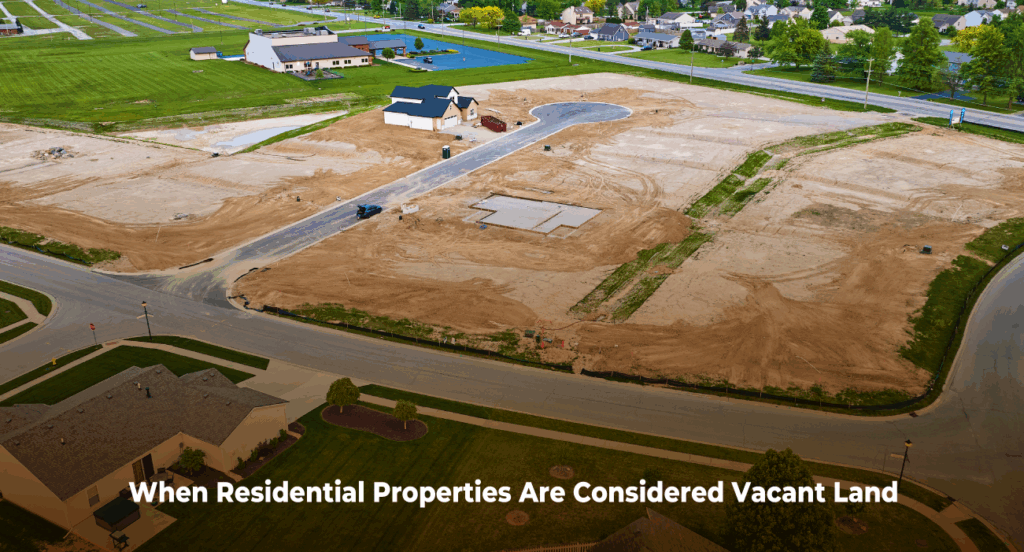
When Residential Properties Are Considered Vacant Land
A residential property may be treated as vacant land even if a house exists. This can occur when:
- the dwelling has been demolished
- the dwelling cannot legally be occupied
- the dwelling has major structural defects
- a knock-down rebuild has commenced
- a natural disaster has rendered the property unusable
In these situations, holding costs generally become non-deductible until the property is rebuilt or repaired.
There are limited exceptions for events such as fires, floods or building defects outside the owner’s control. Under exceptional circumstances, deductions may continue if the owner is genuinely working to restore the property within a reasonable timeframe.
What Does It Mean for a Property to Be Available for Rent?
For holding costs to be deductible, the property must be genuinely available for rent and capable of producing income. This means:
- construction is completed or close to completion
- the dwelling is safe and lawful to occupy
- the property can be advertised or rented
- there is no unreasonable delay caused by the owner
Delays caused by builders, engineers, councils or developers do not automatically grant deduction rights. The key is whether the land already contains a substantial building or a dwelling that is reasonably close to being rent-ready.
Investors should be careful during transitional periods, such as during significant renovations or rebuilds, where the property temporarily becomes non-occupiable. During these periods, the vacant-land rules may apply.
GST Consequences When Selling Vacant Land
The sale of vacant land can trigger GST, depending on how the land has been used. If the owner is carrying on an enterprise — such as property development, subdivision or other commercial activity — the sale will generally be treated as a taxable supply, and GST must be charged on the sale price. However, if the land has been held purely as a private investment with no development activity, the sale is usually outside the GST system.
Owners should also be aware that even limited development work, such as obtaining a DA or preparing the land for subdivision, can be enough for the ATO to view the activity as an enterprise. If GST applies, the purchaser may need to withhold GST at settlement under the GST residential withholding rules.
CGT Consequences for Vacant Land
Under the vacant-land rules, holding costs such as interest, rates, land tax and maintenance are often non-deductible until a substantial and permanent structure exists or construction has genuinely commenced. When these deductions are denied, the expenses do not disappear — they are added to the land’s cost base. This increases the cost base used for future capital-gains-tax calculations when the property is eventually sold.
For investors, this means that while cash-flow deductions may be restricted during the holding period, the denied amounts can reduce the capital gain on disposal. It is important to keep accurate records of all denied holding costs so they can be correctly added to the cost base at sale time.
What Next
The vacant-land rules are detailed and often misunderstood. Many investors settle land with the intention of building an investment property, only to discover months later that their interest, rates and land tax are not deductible. Others unintentionally trigger the rules during a knock-down rebuild or after business activities on the land cease.
Understanding when land is considered vacant, what structures qualify, which exceptions apply, and when a property becomes available for rent is essential for anyone planning to build or redevelop an investment property.
If you are purchasing vacant land, planning a rebuild or dealing with construction delays, now is the perfect time to get proper tax advice. At Investax, we can help you understand your position clearly and structure your plans in a way that protects your deductions and avoids costly mistakes.

We offer a 15-minute free consultation to discuss your tax, property investment and business needs. Book your complimentary consultation now.
Book Now
General Advice Warning
The material on this page and on this website has been prepared for general information purposes only and not as specific advice to any particular person. Any advice contained on this page and on this website is General Advice and does not take into account any person’s particular investment objectives, financial situation and particular needs.
Before making an investment decision based on this advice you should consider, with or without the assistance of a securities adviser, whether it is appropriate to your particular investment needs, objectives and financial circumstances. In addition, the examples provided on this page and on this website are for illustrative purposes only.
Although every effort has been made to verify the accuracy of the information contained on this page and on our website, Investax Group, its officers, representatives, employees and agents disclaim all liability [except for any liability which by law cannot be excluded), for any error, inaccuracy in, or omission from the information contained in this website or any loss or damage suffered by any person directly or indirectly through relying on this information.