


Selecting the optimal investment structure is a pivotal financial decision for investors in Sydney, Australia. Whether you invest in real estate, managed funds, business ventures, or alternative assets, the structure you choose significantly affects tax liabilities, asset protection, wealth distribution, legal obligations, and sustained wealth creation.
At Investax, we specialize in helping investors in Sydney and across Australia identify, evaluate, establish, and optimize investment structures that deliver long‑term tax efficiency, legal protection, and flexibility — tailored to each investor’s unique goals and circumstances.
Considerations for Investment Structure:
When it comes to investment structures, there is no universal “one-size-fits-all” solution. The ideal ownership or investment structure can vary significantly based on various factors, including property investment plans and geographical considerations.

Several factors come into play when establishing and selecting the optimal structure for your investments, including:
- For property investors, the choice of investment structure may differ based on their preferences for investing in various Australian States and Territories.
- Each State and Territory has distinct rules and regulations regarding land tax and land tax surcharges, which can influence the appropriate investment structure for property investors.
- If you are establishing a Trust for your property Investment the States and Territories have different rules regarding the Foreign Beneficiaries.
- Venturing into offshore property investments and borrowing money for overseas ventures may require a different approach to achieve the optimal investment structure.
- Careful consideration of these factors is essential to tailor your investment structure effectively, ensuring maximum efficiency and compliance with specific requirements.
How We Help You?
We empower property and share investors like you to implement effective wealth-creation strategies. From diversifying your portfolio to optimizing risk management, our investment structures provide you with the tools to shape your financial future.
Our experienced team is well-versed in tailoring investment structure setups to suit your unique circumstances, offering expert guidance on tax optimization and asset protection. With a keen focus on risk management and industry-specific considerations, we ensure your investments are strategically structured for long-term success. Whether it’s a Trust, Company, or a combination of both, we work closely with you to create a customized investment structure strategy that precisely matches your goals. Rest assured, Investax’s comprehensive approach empowers you to make informed decisions, providing the confidence and peace of mind you need for a secure financial future.

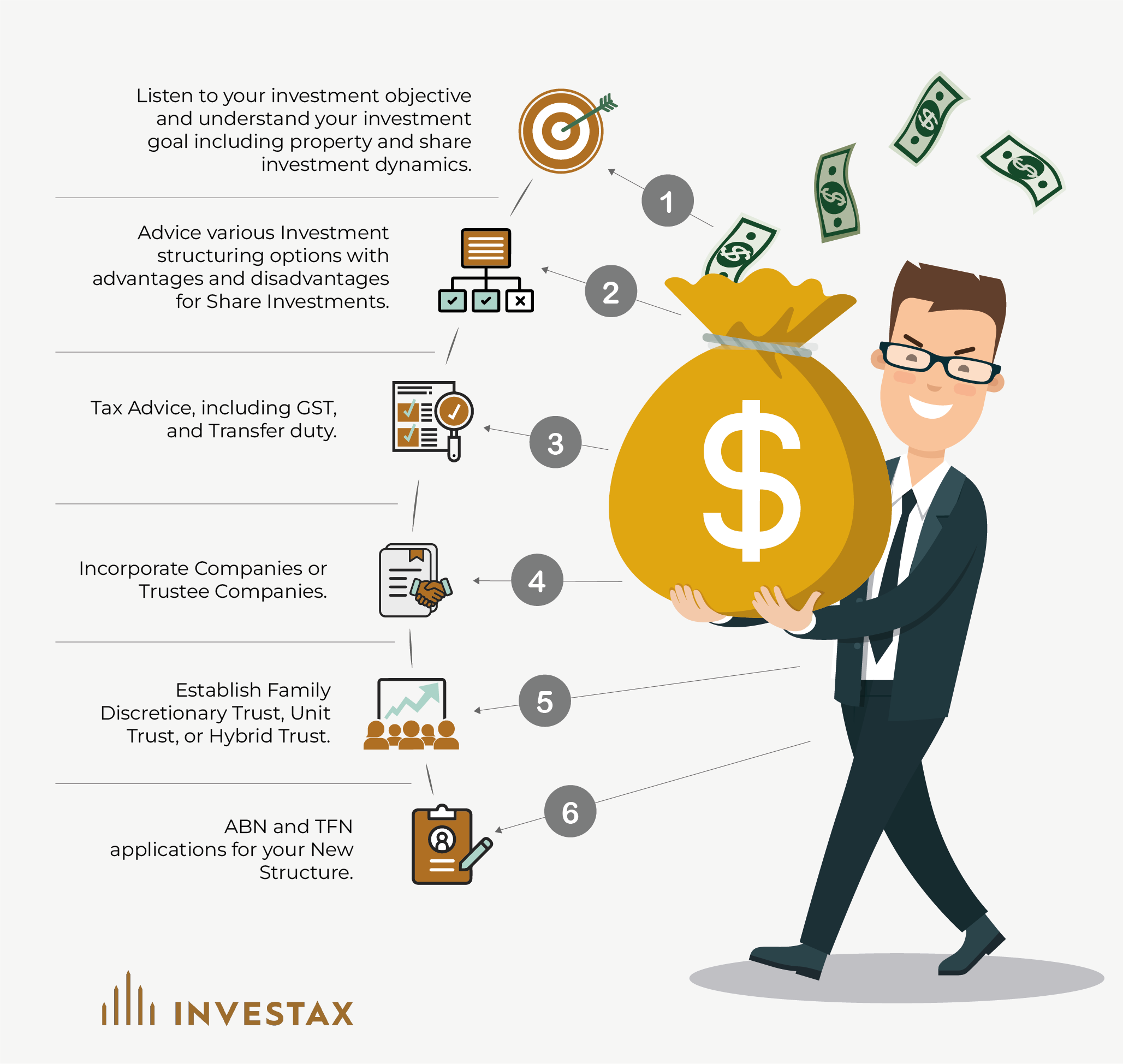
Investment Structure Services in Australia
Choosing the right investment structure is one of the most important decisions for investors who want to build, protect and transfer wealth effectively. Whether the investment involves property, shares, managed funds, business interests, trusts, companies or self-managed superannuation funds, the structure used to hold those assets can affect tax, legal risk, asset protection, cash flow, succession planning and long-term financial flexibility.
At Investax, we provide specialist investment structure services in Australia for property investors, business owners, high-income professionals, families and wealth-focused individuals. Our team helps clients review, design and implement investment structures that support tax efficiency, asset protection and long-term wealth creation.
An investment structure is not just an administrative setup. It determines who owns the asset, how income is taxed, how capital gains are managed, how risk is separated, how wealth is transferred and how future decisions can be made. A structure that works well for one investor may not be suitable for another. The right structure depends on the investor’s goals, income level, asset type, family situation, risk exposure, borrowing needs and long-term plans.
Investax helps clients make informed decisions before investing, restructuring or expanding their portfolio. Whether the goal is to buy an investment property, grow a share portfolio, use a trust, invest through a company, establish an SMSF or plan family succession, our advisers provide practical guidance based on Australian tax and investment considerations.
Why Investment Structure Matters
Investment structure has a direct impact on the way wealth is built and protected. Many investors focus on asset selection but do not give enough attention to how the asset is owned. This can create future tax, legal and estate planning problems.
A poor structure may result in higher tax, limited asset protection, unnecessary land tax exposure, difficulty accessing finance, inflexible income distribution or complications when assets are transferred to family members. In contrast, a well-planned investment structure can provide better control, stronger protection and improved tax planning opportunities.
Investment structure advice may help with:
- Tax-efficient ownership of investment assets
- Capital gains tax planning
- Rental income and investment income management
- Asset protection and risk separation
- Family wealth planning
- Succession and estate planning support
- Trust and company structure review
- SMSF investment considerations
- Joint investment arrangements
- Investment portfolio growth
- Long-term wealth transfer planning
- Ongoing compliance and reporting
Investment structure should be considered before purchasing or transferring assets. Once an asset is already held in a particular structure, changing ownership later may trigger tax, duty, legal and finance consequences. Early advice can help avoid unnecessary restructuring costs in the future.
What Is an Investment Structure?
An investment structure is the legal and financial arrangement used to hold and manage investment assets. It determines ownership, control, tax treatment, liability exposure and distribution of income or gains.
Common investment structures in Australia include:
- Individual ownership
- Joint ownership
- Company structure
- Family trust
- Unit trust
- Partnership
- Self-managed superannuation fund
- Combination structures
Each structure has different advantages and limitations. Individual ownership may be simple, but it may not provide strong asset protection or tax flexibility. A trust may provide flexibility and asset protection benefits, but it requires proper administration. A company may support reinvestment and limited liability, but it has different tax and compliance rules. An SMSF may support retirement-focused investment, but it is heavily regulated and requires careful compliance.
Investax helps clients compare different structures and understand which option may be suitable for their financial goals.
Our Investment Structure Services in Australia
Investax provides a complete range of investment structure services for Australian investors. Our advice is designed to support both new investors and experienced clients with established portfolios.
Our services include:
- Investment structure review
- Trust structure advice
- Company investment structure advice
- SMSF investment structure guidance
- Property investment structure planning
- Share portfolio ownership review
- Joint investment structure advice
- Family wealth structuring
- Asset protection planning
- Capital gains tax planning
- Income distribution planning
- Succession and estate planning considerations
- Ongoing structure review and monitoring
Every investor has a different situation. A property investor may need advice on land tax, negative gearing, capital gains tax and asset protection. A business owner may need to separate business risk from personal investments. A family may want a structure that supports future wealth transfer. A high-income professional may need tax planning and risk management. Investax provides tailored advice based on each client’s circumstances.
Investment Structure for Property Investors
Property investors need careful structure planning because property can create tax, finance, land tax and asset protection issues. The way a property is owned can affect rental income reporting, deductions, capital gains tax, land tax, borrowing, estate planning and future portfolio growth.
Common property ownership options include individual ownership, joint ownership, trust ownership, company ownership and SMSF ownership where appropriate. Each option has different tax and legal implications.
Investax helps property investors review structure before buying, refinancing, restructuring or selling. This may include considering:
- Who should own the property
- How rental income will be taxed
- How loan interest may be treated
- Whether asset protection is required
- Whether land tax may become an issue
- How capital gains tax may apply on sale
- Whether the property fits into a wider family wealth strategy
- Whether the structure supports future purchases
For clients needing property-specific tax advice, our investment property tax services in Sydney can assist with deductions, capital gains tax, negative gearing, depreciation and property tax planning.
Trust Structures for Investments
Trusts are commonly used in Australia for investment and family wealth planning. A trust may provide flexibility in income distribution, asset protection advantages and succession planning benefits when managed properly.
Common trust structures include family trusts, unit trusts and hybrid arrangements. A family trust may be suitable for family wealth planning, while a unit trust may be useful where unrelated investors want clear ownership interests.
However, trusts are not suitable for every investor. They require proper setup, documentation, trust deed review, distribution planning, tax compliance and ongoing administration. Incorrect trust management can create tax and legal problems.
Investax helps clients understand whether a trust structure may be suitable for their investment goals. We also help review existing trust structures to ensure they remain appropriate as assets, income and family circumstances change.
Company Structures for Investments
A company structure may be suitable for some investment situations, especially where limited liability, reinvestment of profits, shareholder arrangements or business-related investment activity is important.
Companies can provide a formal ownership structure and may support long-term growth. However, companies have different tax treatment, compliance obligations and rules around profit distribution. Capital gains tax outcomes may also differ from individual or trust ownership.
Investax helps clients assess whether a company structure is appropriate for their investments. This may include reviewing tax outcomes, asset protection, dividend planning, shareholder arrangements, director obligations and long-term exit plans.
A company structure should be considered carefully before assets are transferred or acquired, as later restructuring may be costly.
SMSF Investment Structure
A self-managed superannuation fund can be an effective investment structure for some Australians who want greater control over retirement savings. SMSFs may invest in assets such as shares, managed funds, term deposits and, under strict rules, property.
However, SMSFs are highly regulated. Trustees must comply with superannuation law, investment strategy requirements, borrowing rules, related-party transaction restrictions and annual audit obligations. SMSF investment decisions should be made carefully and always aligned with retirement objectives.
Investax assists clients with SMSF-related tax and investment structure considerations. For clients needing specialist SMSF services, our SMSF establishment services in Sydney can support setup, structure and compliance planning.
An SMSF should not be used simply because it appears tax-effective. It must be suitable for the investor’s retirement goals, risk profile, balance size and compliance capacity.
Individual and Joint Investment Structures
Individual ownership is often the simplest investment structure. It may be suitable for investors with straightforward circumstances, lower risk exposure or simple asset portfolios. However, individual ownership may provide limited asset protection and tax flexibility.
Joint ownership is common for spouses, family members or investment partners. It allows multiple people to own an asset together. However, income, expenses and capital gains are usually shared according to ownership percentages, and future exit or transfer arrangements should be considered.
Investax helps clients understand whether individual or joint ownership is suitable. We also review whether future asset growth, tax planning, succession needs or risk exposure may require a more structured approach.
Investment Structure for Business Owners
Business owners often need stronger investment structure planning because business risk and personal wealth can overlap. If investments are held personally while the business carries commercial risk, asset protection may become a concern.
A business owner may need to consider separating business operations from investment assets. This may involve company structures, trusts, asset-holding entities or family wealth structures.
Investax helps business owners review investment ownership in the context of business structure, tax planning, asset protection and succession. For broader commercial structuring support, our business structure services in Sydney can assist with business ownership, tax efficiency, risk management and growth planning.
Investment Structure for High-Income Professionals
High-income professionals such as doctors, dentists, lawyers, executives, consultants and specialists often need careful investment structure planning. Higher income levels can increase tax exposure, while professional risk may create asset protection concerns.
Investment structure advice for professionals may include property ownership, trust planning, company structures, SMSF considerations, family wealth planning and capital gains tax strategy.
Investax helps professionals review how investments should be held based on income, family circumstances, risk profile and long-term financial goals. The aim is to build wealth in a way that is tax-aware, compliant and properly protected.
Investment Structure for Families
Families often use investment structures to manage income, protect assets and plan intergenerational wealth transfer. Family trusts, companies and SMSFs may all be considered depending on the circumstances.
Family investment structures need careful planning because they may affect control, tax, distributions, beneficiary rights and estate planning. Poorly structured family investment arrangements can create disputes, tax issues or difficulty transferring wealth.
Investax helps families review structure options and understand how investment assets may be managed across generations. This includes considering who controls the structure, how income is distributed, how assets are protected and how succession may occur.
Tax Efficiency and Investment Structures
Tax efficiency is one of the main reasons investors seek investment structure advice. Different structures can result in different tax outcomes for income, capital gains, deductions and distributions.
Important tax considerations may include:
- Marginal tax rates
- Capital gains tax discount availability
- Trust distribution planning
- Company tax treatment
- Dividend and franking credit considerations
- SMSF tax treatment
- Deductibility of expenses
- Land tax exposure
- Foreign beneficiary issues
- Estate and succession tax implications
Tax should never be the only reason to choose a structure. A structure must also be commercially suitable, compliant and aligned with long-term goals. Investax helps clients balance tax efficiency with risk, flexibility and administration.
Capital Gains Tax Planning
Capital gains tax is a major consideration when choosing an investment structure. The structure used to hold an asset can affect how a capital gain is calculated, whether concessions may be available and how the gain is distributed or taxed.
CGT planning is especially important for property investors, share investors, business owners and families with long-term assets. Planning should happen before selling, transferring or restructuring assets.
Investax helps clients review CGT implications before making investment decisions. This may include cost base review, ownership structure, holding period, trust distributions, company ownership, SMSF considerations and future exit planning.
Asset Protection and Investment Risk
Asset protection is an important part of investment structuring. Investors may face risks from business activity, professional liability, debt, litigation, family disputes, market volatility or creditor claims.
A suitable structure may help separate investment assets from personal or business risk. However, asset protection must be planned properly and implemented before problems arise.
Investax helps clients consider asset protection when selecting or reviewing investment structures. This may involve trusts, companies, separate ownership arrangements or broader wealth protection planning.
Succession and Estate Planning
Investment structure can affect how wealth is transferred to family members or beneficiaries. Assets held personally may be dealt with differently from assets held in trusts, companies or SMSFs.
Succession planning should consider control, ownership, tax consequences, family needs and long-term wealth protection. It is especially important for families with property, business assets, trusts or SMSFs.
Investax helps clients consider succession planning as part of investment structure advice. This helps ensure that investments are not only built effectively but also transferred in a planned and efficient way.
Joint Investment and Investor Groups
Some investments involve multiple investors, business partners, family members or unrelated parties. In these cases, structure is critical because it determines ownership rights, income distribution, decision-making, exit arrangements and dispute management.
A unit trust or company structure may sometimes provide clearer ownership arrangements than informal joint ownership. However, the right option depends on the investment type, investor relationship and long-term plan.
Investax helps investor groups review suitable structures and understand tax and commercial implications before capital is committed.
Ongoing Investment Structure Review
An investment structure should not be treated as a once-off decision. Tax laws, family circumstances, income levels, asset values and investment goals can change over time. A structure that was suitable five years ago may no longer be the best option.
Investax recommends regular structure reviews, especially when:
- Buying a new investment property
- Selling a major asset
- Starting or selling a business
- Receiving an inheritance
- Changing family circumstances
- Bringing in investment partners
- Planning retirement
- Establishing or reviewing an SMSF
- Moving assets between entities
- Expanding a portfolio
Ongoing review helps ensure the structure remains tax-effective, compliant and aligned with long-term goals.
Common Investment Structure Mistakes
Many investors make structure decisions without considering future consequences. Common mistakes include:
- Buying assets in personal names without considering asset protection
- Using a trust without understanding compliance obligations
- Holding property in a company without reviewing CGT outcomes
- Ignoring land tax implications
- Mixing business risk with personal investments
- Not planning for capital gains tax before sale
- Failing to document joint investment arrangements
- Not reviewing structures as wealth grows
- Using an SMSF without understanding trustee responsibilities
- Transferring assets without considering tax and duty consequences
- Not planning for succession or estate control
Investax helps clients avoid these mistakes through early advice, careful review and practical implementation support.
Our Step-by-Step Investment Structure Process
Step 1: Understanding the Investor’s Goals
We begin by understanding the client’s investment goals, income position, assets, family situation, risk profile and long-term plans.
Step 2: Reviewing Current Assets and Structure
We review existing investments, ownership arrangements, loans, entities, trusts, companies or SMSFs where relevant.
Step 3: Identifying Tax and Risk Issues
Our team identifies potential tax, CGT, land tax, asset protection, compliance and succession issues.
Step 4: Comparing Structure Options
We compare suitable structures such as individual ownership, joint ownership, trusts, companies, partnerships and SMSFs.
Step 5: Recommending a Tailored Strategy
We recommend a structure or structure review plan based on the client’s goals, tax position, risk exposure and future needs.
Step 6: Supporting Implementation
We assist with implementation planning and coordinate with legal advisers, financial planners and other professionals where required.
Step 7: Ongoing Monitoring
We provide ongoing review as investments grow, tax laws change or family and business circumstances evolve.
Why Choose Investax for Investment Structure Services in Australia?
Investax provides investment structure advice with a strong focus on tax strategy, asset protection and long-term wealth creation. Our team understands that investment decisions should be supported by the right ownership and tax framework.
Clients choose Investax because we provide:
- Specialist investment structure advice for Australian investors
- Property, trust, company and SMSF structuring guidance
- Tax-efficient investment planning aligned with long-term goals
- Capital gains tax and asset protection considerations
- Support for high-income professionals, business owners and families
- Succession and estate planning awareness
- Clear, practical explanations without unnecessary complexity
- Ongoing review as investment portfolios grow
For broader international investment and tax policy context, the OECD tax policy centre provides useful global tax resources. For general global financial sector and investment development information, the World Bank Financial Sector resource may also be useful.
Speak with an Investment Structure Adviser in Australia
Investment structure decisions can affect tax outcomes, asset protection, family wealth planning and long-term financial flexibility. Whether the goal is to buy property, grow a portfolio, establish a trust, invest through a company, use an SMSF or plan future succession, the right advice can help avoid costly mistakes.
Investax helps Australian investors choose, review and improve investment structures with practical tax and commercial guidance. Our team provides tailored support for property investors, business owners, high-income professionals, families and wealth-focused individuals.
Contact Investax today to speak with an investment structure adviser and receive professional guidance for building a tax-effective, protected and future-ready investment strategy.
What is the difference between joint tenants and tenants in common when buying property with others?
Joint tenants and tenants in common are two common ways to co-own property. Joint tenants have an equal share in the property, and if one owner passes away, their share automatically transfers to the surviving joint tenant(s). In contrast, tenants in common can have unequal shares, and if one owner passes away, their share is passed on according to their will or intestacy laws, not necessarily to the co-owners.
What are the advantages of buying property through a company?
Purchasing property through a company can provide limited liability, protecting your personal assets from the property’s debts or legal issues.
What are the benefits of using a trust for property investment?
Trusts offer flexibility in distributing income and can provide tax advantages. For example, discretionary trusts allow income to be distributed among beneficiaries, potentially reducing the overall tax liability. Additionally, trusts are often used for asset protection and estate planning purposes.
How does property investment through a partnership work?
In a property investment partnership, two or more individuals or entities pool their resources to purchase and manage a property. Partnerships can have varying structures, and profits and losses are typically distributed according to the partnership agreement.
Can I change the property investment structure after purchase?
Changing the property investment structure after purchase is possible but can be complex and may have legal and tax implications such as stamp duty and Capital Gain. Consult with legal and Tax experts before making any changes to your property ownership structure.
Can I sell/Transfer the property for $1?
While you can technically sell a property for $1, several crucial considerations apply. Tax authorities and legal entities typically assess property transactions based on market value, potentially resulting in tax obligations based on the property’s actual worth, despite the nominal sale price. Stamp duty, capital gains tax, and legal and financial implications, particularly if there are existing mortgages or loans, should be thoroughly evaluated.
What is a testamentary trust?
A testamentary trust is a trust that is established through a person’s will and takes effect upon their death. It allows the testator (the person making the will) to specify how their assets will be managed and distributed after their passing. Testamentary trusts are commonly used for various purposes, including providing for the financial needs of beneficiaries, protecting assets from potential creditors, and minimizing tax liabilities. These trusts can be highly customizable, and the terms and conditions are typically outlined in the testator’s will, providing detailed instructions on how the trust is to be administered for the benefit of specific beneficiaries.
Can we claim a Primary Residence Exemption for a property owned by a Trust?
The main residence exemption under the CGT rules cannot generally apply to properties owned by a trust. The main residence exemption can generally only apply when the dwelling is owned by an individual – refer to section 118-110 ITAA 1997. There are some very limited exceptions to this including: Where the property is held by a special disability trust. Where the property was owned by an individual just before they died and is now held in a deceased estate or testamentary trust, there are some special rules which can potentially enable the main residence exemption to apply; or Where the occupier of the property is absolutely entitled to the property as against the trustee.
What and Who is a Settlor?
he Settlor is the individual who “settles” a discretionary trust by transferring the settled sum to the Trustee (or Trustees). The Settlor must also actually transfer the settled sum. If they fail to do so, the Trust will not come into existence. For a trust to be established, there must be trust property. In most situations, this trust property originates from the settled sum.