

SMSF Property Investing in 2026: The Strategic Guide for Sydney Investors


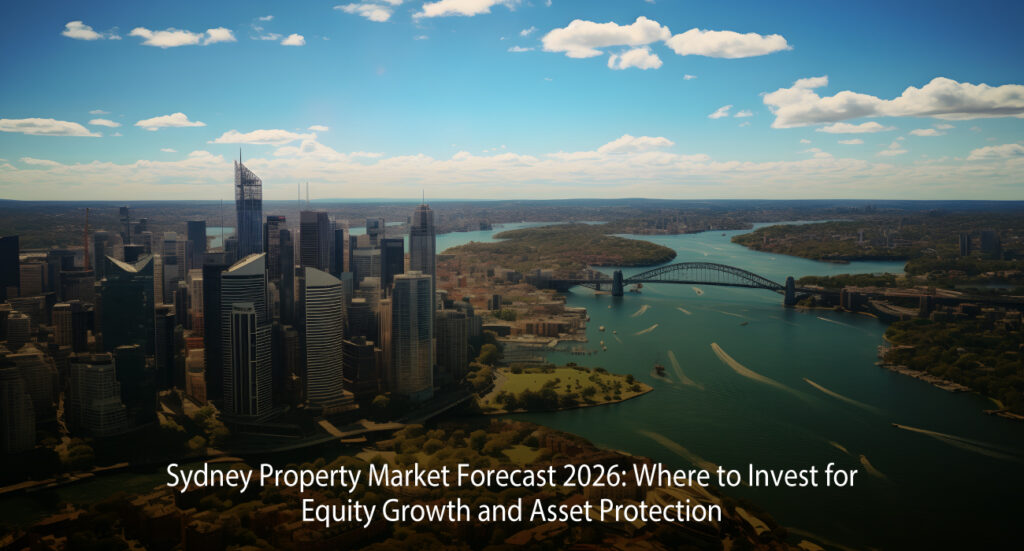
Sydney Property Market Forecast 2026: Where to Invest for Equity Growth and Asset Protection
April 16, 2026 |
Introduction: The “Two-Speed” Market of 2026 As we move through the second quarter of 2026, the Sydney property landscape is telling two very different stories. While the premium end of the market—those high-end $5M+ harbour-side retreats—is seeing a modest softening, the “lower-quartile” affordable hubs are in a state of rapid acceleration. Recent data from Q1 2026 highlights a striking divergence: affordable corridors in Western Sydney grew by 1.8%, while the upper quartile fell by an equal 1.8%. At Investax Group, we believe the “sweet spot” for 2026 isn’t just about where you buy, but how you structure that purchase to navigate a year defined by tight supply, high demand, and significant new lending rules.
The “Aerotropolis” & The Metro Effect:
In 2026, the single biggest driver of Sydney property value is infrastructure completion. We have moved past the “planning” phase and into the “operational” phase for several multibillion-dollar projects.
- The Western Sydney International Airport (WSI): Opening in October 2026, the Nancy-Bird Walton airport is no longer a concept—it is an employment engine. Suburbs like Leppington and Austral have already seen annual growth exceeding 10%, but with the M12 Motorway now open toll-free (as of March 2026), the “connectivity premium” is just beginning to settle into prices.
- The Metro Southwest Integration: The conversion of the Bankstown line to Metro standards is reshaping the inner-southwest. Bankstown and Lidcombe have emerged as the surprise heavyweights of 2026, with some pockets seeing growth of over 20% as buyers trade inner-west proximity for the speed and reliability of the Metro.
- The Parramatta “Second CBD”: Parramatta has officially transitioned into a high-yield powerhouse. With median unit prices around $620,000 and yields pushing 5.7%, it has become the go-to for investors looking for cash flow to offset current interest rates.

The February 2026 APRA Pivot (Protecting Your Borrowing Power)
Buying property in Sydney in 2026 requires a deeper level of financial strategy than in previous years. On February 1, 2026, the Australian Prudential Regulation Authority (APRA) officially activated new Debt-to-Income (DTI) caps.
This is the “Equity Trap” we warn our clients about. Under these rules, most banks must now limit the number of loans they issue where the borrower’s total debt is more than six times their gross income.
Why this matters for your Asset Protection: If you buy property in your personal name, you may quickly hit a “financing wall,” where your DTI ratio prevents you from acquiring your next asset. This is where Investax Group’s expertise in entity structuring becomes a critical investment tool. By utilizing Family Trusts or Corporate Trustees, we can often help you:
- Isolate Debt: Structure your portfolio to manage how lenders view your overall debt position.
- Protect Equity: Shield your growing property wealth from professional liability or litigation.
- Optimize Tax: Navigate the 2026 NSW land tax thresholds to ensure you aren’t overpaying as your portfolio scales.
The Investax “Top 3” Sydney Suburbs with High Growth Activity:
When evaluating the Sydney market in 2026, Investax Group looks at data-driven indicators such as infrastructure proximity and supply-demand ratios. Based on the latest CoreLogic (Cotality) and ABS datasets, several corridors are currently demonstrating strong equity-growth indicators:
- Infrastructure Corridor (St Marys & surrounds): Currently showing double-digit growth (approx. 14.2% YoY) as a result of the Metro Western Sydney Airport line integration.
- The ‘Metro Premium’ (Bankstown & Canterbury): These hubs are seeing a “connectivity spike” as the Southwest Metro conversion nears completion, often outperforming the broader Sydney median.
- Yield Recovery Zones (Merrylands & Parramatta): High-density zones are currently attracting interest due to gross rental yields pushing toward 6% in some pockets—a critical factor for cash-flow management in a high-interest environment.
Note: These areas are mentioned as case studies of market movement, not as specific investment recommendations. Every property within these suburbs carries different risks and tax implications.

Navigating the 2026 NSW Land Tax Thresholds
As an investor, your “Equity Growth” can quickly be eroded by “Tax Leakage” if you aren’t careful. For the 2026 tax year, Revenue NSW has confirmed the general land tax threshold remains at $1,075,000.
Why a “Hold Strategy” matters:
- The Individual Threshold: If your combined NSW landholdings (unimproved value) exceed $1,075,000, you pay 1.6% + $100 on every dollar above that mark.
- The Trust Trap: Many discretionary trusts in NSW do not receive a threshold, meaning you pay 1.6% from the very first dollar.
- Investax Strategy: We help our clients balance the “cost of tax” against the “value of protection.” In many cases, the asset protection provided by a trust outweighs the land tax cost, especially as Sydney land values continue to climb toward the $6.57M Premium Threshold.

Conclusion: Don’t Let the 2026 Market Outpace Your Strategy
The 2026 Sydney market is no longer a place for “accidental” investors. With the median house price inching toward $2 million and the APRA DTI caps tightening the noose on borrowing capacity, the gap between those who grow and those who stall is Structure.
In this “two-speed” economy, simply picking a growth suburb like St Marys or Bankstown isn’t enough. If your purchase isn’t shielded by a robust asset protection strategy or optimized for the latest NSW tax thresholds, your equity growth could be swallowed by litigation, land tax, or a “financing wall.”
At Investax Group, we don’t just look at the numbers on a bank statement; we look at the blueprint of your future wealth. Whether you are navigating the Western Sydney Aerotropolis boom or restructuring a portfolio to bypass new lending restrictions, we provide the tax and accounting expertise to keep your momentum high.
References & Data Sources
- CoreLogic (Cotality) Home Value Index (April 2026): Sydney market performance and lower-quartile growth trends.
- Australian Bureau of Statistics (ABS): 2026 Building Approvals and Residential Property Price Index (Sydney GCCSA).
- Revenue NSW (March 2026): Updated General and Premium Land Tax Thresholds.
- APRA Quarterly Statistics (Feb 2026): Updated Debt-to-Income (DTI) lending requirements and risk benchmarks.
- NSW Valuer General (2025/26): Annual land valuation trends for Metropolitan Sydney.

We offer a 15-minute free consultation to discuss your tax, property investment and business needs. Book your complimentary consultation now.
Book Now
General Advice Warning
The material on this page and on this website has been prepared for general information purposes only and not as specific advice to any particular person. Any advice contained on this page and on this website is General Advice and does not take into account any person’s particular investment objectives, financial situation and particular needs.
Before making an investment decision based on this advice you should consider, with or without the assistance of a securities adviser, whether it is appropriate to your particular investment needs, objectives and financial circumstances. In addition, the examples provided on this page and on this website are for illustrative purposes only.Although every effort has been made to verify the accuracy of the information contained on this page and on our website, Investax Group, its officers, representatives, employees and agents disclaim all liability [except for any liability which by law cannot be excluded), for any error, inaccuracy in, or omission from the information contained in this website or any loss or damage suffered by any person directly or indirectly through relying on this information.